
What is it really like living next to a construction site ?


Living next to a construction site can be a strange experience.
Some days may feel almost normal, with only light vehicle movements or workers arriving on site. Other days can feel much more intrusive, especially when demolition, excavation, rock breaking, concrete cutting, piling, reversing vehicles or heavy machinery are involved.
Construction is a necessary part of growing cities such as Brisbane and the Gold Coast. New homes, apartments, transport projects, schools, hospitals and commercial buildings all need to be built somewhere. But for the people living or working next door, the construction phase can affect daily life in very real ways.
Noise complaints are one sign of this tension. In Brisbane, older publicly reported Brisbane City Council figures showed 10,745 suburban noise complaints in 2016–17, including 1,661 complaints about builders working out of hours. On the Gold Coast, publicly reported City of Gold Coast figures recorded 4,644 noise complaints over a 12-month period in 2023. These figures cover broader noise complaints rather than only construction noise, but they show that noise is not a minor issue for urban communities.
The important point is that construction noise is not just about “how loud” something is. It is also about when it happens, how long it lasts, what kind of sound it makes, where the listener is, and whether people were prepared for it.

Construction noise is not one type of noise
A common mistake is to think of construction noise as one single problem.
In reality, a construction site contains many different noise sources, each with its own character. Typical examples include excavators, loaders, cranes, concrete trucks, pumps, rock breakers, compactors, saws, grinders, generators, compressors, reversing alarms, radios, shouting, impact noise and materials being moved around the site.
Some sounds are steady. Others are sudden, sharp or repetitive. Some are tonal, metallic or high-pitched. These characteristics matter because people do not respond to all sounds in the same way.
A steady engine hum may eventually fade into the background. A reversing alarm, dropped steel component, concrete saw or repeated rock breaker impact can draw attention immediately, even if the measured average sound level does not look extreme.
That is one reason construction noise can be difficult for residents to describe. They may not simply mean “it is loud”. They may mean it is unpredictable, startling, early, repetitive, tonal, physically felt through the building, or impossible to ignore while working from home.
Why construction noise feels worse at certain times

Construction noise often feels more intrusive early in the morning, in the evening or during otherwise quiet parts of the day.
That is partly because the surrounding environment is quieter. A truck reversing at 7:00 am may feel much more noticeable than the same truck movement at midday beside a busy road. The sound has less background noise to hide behind.
This is why timing is such an important part of construction noise management.
Generally, in QLD building work noise is allowed from 6:30 am to 6:30 pm, Monday to Saturday, including Saturday public holidays. Outside those times, no clearly audible building work noise is allowed within an affected building unless an approval or condition allows it.
The Gold Coast applies the same broad standard hours for building work noise: audible building work noise must not occur before 6:30 am or after 6:30 pm, Monday to Saturday, and must not occur on Sundays. The City of Gold Coast also states that a permit is required for building work outside normal hours.
These hours do not mean every construction impact will be acceptable in every situation. They provide the baseline regulatory framework. Good construction management still needs to consider the type of work, proximity to neighbours, vibration risk, sensitive receivers and communication.
Sudden and unpredictable sound events are much harder for the brain to ignore than steady background noise.

The activities people usually notice most
Not all construction activities have the same acoustic impact.
The activities most likely to trigger concern are usually those that are loud, impulsive, repetitive, tonal, vibration-generating or difficult to predict.
Demolition
Demolition can involve breaking, cutting, dropping and removing material. It can create sudden impact noise and vibration, particularly where concrete, masonry or steel are involved.
Excavation and rock breaking
Excavation may be manageable in some soil conditions, but rock breaking can be one of the most intrusive construction activities. It produces repeated impact noise and can also generate ground vibration.
Piling
Piling can be noticeable because of its repetitive nature and potential vibration effects. The method matters. Some piling methods are much more intrusive than others.
Concrete cutting and sawing
Concrete cutting can create a high-pitched or tonal sound that carries clearly through urban areas, especially where hard building façades reflect sound.
Heavy vehicle movements
Trucks are not always the loudest source, but they are often noticed when they arrive early, idle, queue, reverse, use ramps or pass close to homes.
Brisbane City Council specifically identifies high-noise activities such as demolition, blasting, pile driving, concrete or bitumen cutting, metal cutting and rock breaking as activities that are more suitable during daytime or early evening periods. For Brisbane out-of-hours construction approvals, Council states that high-noise generating activities are not permitted between 10:00 pm and 6:30 am.
Noise is not the only issue:
Vibration matters too

Although this article focuses mainly on construction noise, vibration is often part of the same conversation.
People living near construction sites may also experience vibration from construction activities through floors, walls, windows, furniture or beds. It may come from activities such as compacting, piling, excavation, demolition, rock breaking or heavy vehicle movements.
Vibration is different from airborne noise. Noise travels through the air and is heard. Vibration travels through the ground or building structure and is felt. That physical sensation can make vibration feel more concerning, even when levels are below those typically associated with building damage.
For residents, vibration can raise understandable questions:
What activity is causing it?
How long will it continue?
Is it expected?
Could it affect the building?
Has a condition report been done for your property?
Is monitoring required?
Who should be contacted if the vibration changes?
This is why vibration should not be dismissed as “just part of construction”. Even where the technical risk is low, the human response can be significant. Feeling a building move, hearing windows rattle or noticing vibration through a bed or desk can affect comfort, concentration and confidence.
However, construction vibration is a large topic in its own right. It involves different assessment methods, criteria and management strategies from airborne noise. For that reason, this article only introduces vibration as part of the broader construction experience. A separate article can look more closely at how construction vibration is measured, what levels may be perceptible, when monitoring is useful and how vibration risk is managed.

What good construction
noise and vibration management looks like
Good construction noise management does not mean making a construction site silent. That is unrealistic.
A better goal is to understand the likely impacts, reduce avoidable noise, manage the most intrusive activities carefully and communicate clearly with the people most likely to be affected. The same principle applies to vibration. Not all construction vibration can be eliminated, but higher-risk activities should be identified early, assessed where needed and monitored where there is a reasonable risk of disturbance, concern or potential building effects.
At a high level, good practice includes:
understanding nearby sensitive receivers and the surrounding site context
identifying the main noise and vibration risks before disruptive work begins
planning work methods, timing and equipment choices to reduce avoidable impacts
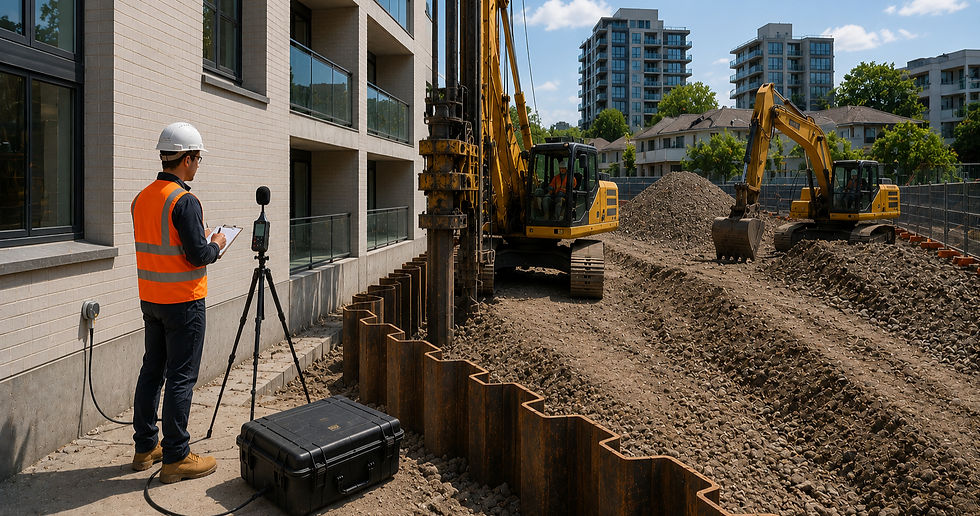
using noise and vibration monitoring where risk, complaints or approval conditions warrant it
setting clear trigger levels and response actions for unexpected results
communicating clearly with affected neighbours before and during disruptive works
reviewing the management approach as the project changes
Noise and vibration monitoring can be useful, but it should not be treated as a solution by itself. Monitoring helps confirm what is happening, identify when levels change and support a faster response if agreed trigger levels are approached or exceeded. The real value comes from linking monitoring to action, such as reviewing work methods, adjusting equipment, changing timing, improving communication or investigating unexpected results.
For Brisbane out-of-hours construction, Council requires a site-specific and current out-of-hours construction noise management plan as part of the application documents. Brisbane City Council also refers to notifying affected premises or residents about the after-hours contact, date and time of work, and type of construction activity proposed.
The City of Gold Coast similarly explains that a Construction Management Plan may be required to manage disruption to the local community, depending on the nature and location of the work.
Where a formal Construction Noise and Vibration Management Plan is required, it should be site-specific, practical and easy to implement. It should define responsibilities, identify sensitive receivers, outline communication procedures, describe when noise and vibration monitoring will be used, and explain what happens if trigger levels are exceeded.
A good CNVMP is not a static document prepared once and forgotten. It should evolve with the project lifecycle, because the noise and vibration risks during demolition, excavation, structure, fit-out and commissioning are not the same.
Managing expectations before complaints escalate

From a resident’s point of view, one of the biggest issues is often uncertainty.
People can usually tolerate some construction disruption if they understand what is happening, why it is happening and when it is likely to end. Problems tend to escalate when residents feel surprised, ignored or unable to get a clear answer.
Most residents want practical information: advance notice before very noisy work, realistic timeframes, clear work hours, a responsive contact person, reduced early-morning disturbance where possible, and confidence that noise and vibration are being taken seriously.
For builders and developers, this means construction noise and vibration should not be left until complaints start. By then, trust may already be damaged.
Early acoustic advice can help identify the activities most likely to affect neighbours, whether noise or vibration monitoring may be useful, whether temporary screening is practical, whether equipment or methodology changes could reduce impacts, and what should be included in a Construction Noise and Vibration Management Plan.
This is particularly important for projects near homes, apartments, schools, hospitals, child care centres, aged care facilities, hotels, offices or other sensitive uses.
The best time to manage construction noise and vibration is before the loudest or most disruptive work begins.
Final thoughts
Living next to a construction site is rarely peaceful, but construction itself is not the problem. Cities need new homes, infrastructure, schools, hospitals and public spaces. The real issue is how disruption is planned, communicated and managed.
Construction work is temporary, but for nearby residents, temporary disruption can still become part of everyday life.
That is why construction noise and vibration are not just technical issues. They are also community issues. A short, sharp activity at the wrong time can be more disruptive than a steadier sound during the day. A well-communicated noisy activity may be tolerated better than an unexpected one. A temporary barrier may help with airborne noise in one situation and do very little in another. Vibration may need a different response again.
Builders and developers have an important responsibility to manage noise, vibration, communication and complaints before issues escalate. But the responsibility should not sit with builders alone. State agencies and councils also need to recognise the cumulative exposure experienced by residents, especially in areas undergoing repeated development, infrastructure upgrades or long periods of staged construction.
A single project may appear manageable when assessed in isolation. For residents, however, the lived experience may be months or years of overlapping works, changing traffic conditions, early starts, vibration, dust, reversing alarms and uncertainty about what comes next.
Getting acoustic advice early can reduce risk, improve communication and help turn construction noise and vibration from a source of conflict into something more predictable, transparent and better managed.
I would love to hear about your experience: what factors have made living with construction noise or vibration easier or more difficult?


Comments