
What is it really like living next to a service station?

Updated: May 19

Why certain sounds suddenly stand out?
I grew up near a family-owned service station in Bangkok, Thailand, so the sounds of these environments have been familiar to me for most of my life. Early morning deliveries, the constant flow of traffic during the day, vehicles arriving late at night, refrigeration equipment humming in the background and the changing rhythm of activity throughout the day were simply part of the everyday soundscape.
Looking back now as an acoustic consultant, I still find it interesting how differently people experience these environments. Some barely notice them, while others become highly sensitive to certain sounds, particularly at night.
I remember how different the environment felt after dark compared with daytime trading hours. During the day, surrounding traffic and urban activity blended together into a relatively constant background. At night, however, any sound events became much more noticeable, such as a truck air brake, a metal gate closing or refrigeration equipment cycling on in otherwise quiet conditions.
None of these sounds were necessarily extremely loud. Yet they seemed to stand out far more clearly after dark.

Noise is not just about loudness
One of the most common misunderstandings about environmental noise is the assumption that louder always means more disturbing.
In reality, people often respond more strongly to changes in sound than to steady background noise itself.
Human hearing is highly sensitive to change. From an evolutionary perspective, sudden or unusual sounds often carried important information about the surrounding environment. Because of this, constant sounds frequently fade into the background of perception over time, while intermittent or unexpected sounds attract attention much more easily.
This concept is often described in acoustics as emergence, the degree to which a sound stands out relative to the surrounding environment.
For example, a distant roadway may produce a relatively stable background sound that gradually becomes part of everyday life. In contrast, a single truck braking late at night or a refrigeration unit suddenly switching on may feel disproportionately intrusive because it interrupts an otherwise steady acoustic environment.
In many cases, people are disturbed less by the average sound level over an entire day and more by the individual sound events that interrupt rest, concentration or sleep.
Why service stations can feel acoustically different at night

Service stations are interesting acoustic environments because they rarely produce one continuous sound source. Instead, they often generate a sequence of intermittent sound events throughout the day and night.
During the day, surrounding traffic and urban activity can partially mask these sounds. Late at night, however, when ambient noise levels decrease, individual sound events become much more exposed.
Examples can include:
fuel tanker deliveries,
truck air brakes,
car doors closing,
refrigeration systems cycling on and off,
pressure cleaning,
voices at normal vocal effort in otherwise quiet conditions,
the clanking sound of fuel nozzles against vehicle tanks or pump holders,
steel drainage grates rattling as vehicles roll over them,
or vehicles accelerating away from intersections.
Again, many of these sounds may not be extremely loud in isolation. Their impact often comes from the way they emerge from the background environment and draw attention.
This is one reason why two locations with similar measured noise levels can feel completely different to the people living nearby.
The surrounding soundscape matters
An important part of acoustic comfort and amenity is context.
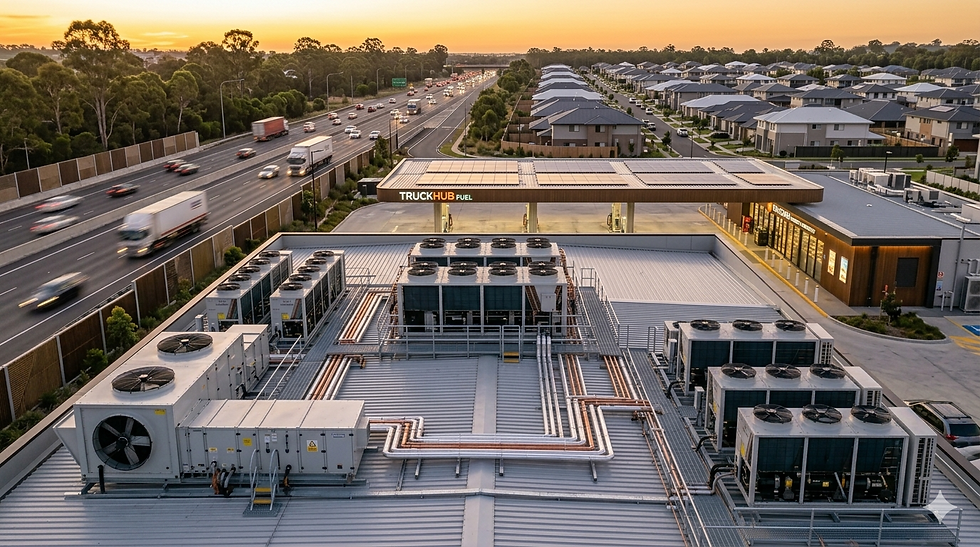
A refrigeration unit operating continuously beside a busy arterial road may barely attract attention because it blends into the surrounding environment. The same equipment operating within a quiet suburban street late at night may become highly noticeable.
Similarly, a service station located within an active commercial precinct may feel acoustically very different from one positioned beside low-density residential housing, even if the operational activity is similar.
This is why environmental acoustic assessments cannot rely solely on isolated sound measurements without understanding the broader soundscape in which those sounds occur.
The character of an environment, not just its overall loudness, strongly influences how people experience noise.
What should buyers and residents pay attention to?

For people considering purchasing or renting property near a service station, it can be useful to think beyond daytime impressions alone.
A location that feels relatively quiet during business hours may behave very differently late at night or during early morning delivery periods.
Useful things to observe can include:
whether the site operates 24 hours,
where and when fuel deliveries occur,
whether trucks regularly visit the site,
the location of refrigeration or mechanical equipment,
nearby reflective building surfaces,
and whether bedroom windows directly face operational areas.
A carefully planned dwelling design or subdivision would have considered most of these aspects.
It can also help to visit the area during more acoustically sensitive periods, when intermittent sound events are likely to become more noticeable.
Final thoughts
Living near a service station does not automatically mean living in a noisy environment. Many sites coexist successfully within residential communities. However, environmental noise is often more complex than a single decibel number.
Environmental noise is rarely experienced as a single number. The way sound changes over time, emerges from the background and interacts with human attention often shapes our perception far more than loudness alone.
People do not simply hear sound, they notice change.
Perhaps that is why a single unexpected sound at night can sometimes feel more intrusive than the constant activity of an entire day.
Which sound in your surroundings stands out more after all the hustle and bustle?
I would love to hear your experience.


Comments